10.12.2009


Chin-Kee in Hollywood.
The news piece below is especially intriguing and relevant after having just read American Born Chinese and discussed racial and cultural stereotypes and caricatures.
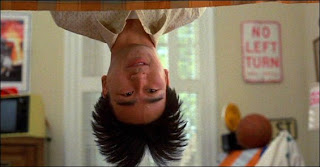
Excerpt:
Long Duk Dong was the foreign-exchange student, fresh from some unidentified Asian country, in the popular 1984 high-school comedy Sixteen Candles—comic relief in a movie with more than its share of slapstick.
When we launched In Character, we set out to explore fictional characters who had left a mark on American culture. The mark Long Duk Dong left was more of a stain: To some viewers, he represents one of the most offensive Asian stereotypes Hollywood ever gave America.
Read (or listen) to the full segment here: Long Duk Dong: Last of the Hollywood Stereotypes?
Also worth checking out: NPR: "Are Positive Stereotypes Racist, Too?"

Excerpt:
Long Duk Dong was the foreign-exchange student, fresh from some unidentified Asian country, in the popular 1984 high-school comedy Sixteen Candles—comic relief in a movie with more than its share of slapstick.
When we launched In Character, we set out to explore fictional characters who had left a mark on American culture. The mark Long Duk Dong left was more of a stain: To some viewers, he represents one of the most offensive Asian stereotypes Hollywood ever gave America.
Read (or listen) to the full segment here: Long Duk Dong: Last of the Hollywood Stereotypes?
Also worth checking out: NPR: "Are Positive Stereotypes Racist, Too?"
10.11.2009
Q1, week 7 skedj.
Monday.
In class: Stereotypes and socialization (continued).
Homework: Finish ABC.
Tuesday.
In class: Wrapping up ABC.
Homework: Story board Comic Life project.
Wednesday & Thursday.
No class, conferences.
Friday.
No school.
In class: Stereotypes and socialization (continued).
Homework: Finish ABC.
Tuesday.
In class: Wrapping up ABC.
Homework: Story board Comic Life project.
Wednesday & Thursday.
No class, conferences.
Friday.
No school.
10.07.2009
Weekend blog post: Does acknowledging a stereotype perpetuate it?
Address the question above in one to two thoughtful and articulate paragraphs. Your sentences should be complete and grammatically, mechanically sound.
To avoid losing your work and having to start over, I suggest typing first in a Word document and then copying and pasting into the blog comment field.
To avoid losing your work and having to start over, I suggest typing first in a Word document and then copying and pasting into the blog comment field.
10.06.2009
10.05.2009
Growing Up Chinese, Graphically.
 Gene Luen Yang, high school teacher and cartoonist, spoke with National Public Radio about his graphic novel, American Born Chinese, the first graphic novel to be nominated for a National Book Award. Listen to the program and view an audio slide show at:
Growing Up Chinese, Graphically.
Also worth checking out from Gene Yang:
- Masters thesis: Comics in Education.
- a graphic art math lesson on factoring: Factoring with Mr. Yang & Mosley the Alien.
- New York Times Magazine "Funny Pages" feature: "Prime Baby."
Graphic novels glossary of terms and ABC allusions.
Graphic novel lingo:
- panel: a box which contains a given scene (box, frame).
- border: the outline of the panel.
- gutters: the space between panels.
- tier: row of panels (left to right) on page.
- balloons: the container of the text- dialogue spoken by the characters.
- tail: pointer leading from balloon to speaker.
- gesture: human movement or expression.
- posture: attitude of the body.
- Journey to the West (also known as Monkey King): the third of the Four Great Classical novels of Chinese literature. (The other three are Romance of the Three Kingdoms, Water Margin, and Dream of the Red Chamber.) The Four Great Classical Novels are considered to be the pinnacle of China's achievement in classical novels, influencing the creation of many stories, theater, movies, games, and other entertainment throughout East Asia including China, Japan, Korea, and Vietnam.
- The lion, the human, the ox, and the eagle: references to the cardinal directions; perhaps thought to be Biblical allusions as well.
10.04.2009
Q1, week 6 skedj.
Monday.
In class: Memoir peer-edit.
Homework: Memoir final draft.
Day 2.
In class: How to read a graphic novel. Begin American Born Chinese, pp. 1-84 (84).
Homework: Memoir final draft.
Day 3.
In class: Stereotypes and socialization.
Homework: ABC pp. 85-160 (76) and blog post. See Weekend blog post above.
Friday.
Legacy Day; no classes.
In class: Memoir peer-edit.
Homework: Memoir final draft.
Day 2.
In class: How to read a graphic novel. Begin American Born Chinese, pp. 1-84 (84).
Homework: Memoir final draft.
Day 3.
In class: Stereotypes and socialization.
Homework: ABC pp. 85-160 (76) and blog post. See Weekend blog post above.
Friday.
Legacy Day; no classes.
Subscribe to:
Posts (Atom)


 Posts
Posts


